


Managing CMMC Risk Throughout Your Contract Lifecycle
CMMC enforcement is here. With DFARS clauses 7021 and 7025 now active across the defense industrial base (DIB), contractors face enforceable obligations that extend beyond prime contractors to every tier of the supply chain. While primes have received significant attention, subcontractors encounter distinct challenges in managing CMMC risk from pre-award decisions through contract execution and ongoing compliance maintenance.
The January 2025 DoD FAQs eliminated several gray areas, yet confusion persists around scope definition, CMMC flowdown requirements, and supply chain risk management. Managing CMMC risk isn’t a one-time event—it’s a continuous process spanning the entire contract lifecycle. This guide addresses the latest DoD guidance, scope ownership, aligning perception with reality, navigating flowdown requirements, and managing tiered supply chain risk.
Latest DoD FAQs: Eliminating Gray Areas
The Department of Defense recently clarified common misconceptions through three January 2026 FAQs that set new expectations for contractors:
C-Q10 (Hard Copy CUI): Organizations handling only hard-copy CUI are not subject to CMMC assessment. However, the moment that data touches a digital system—scanned, emailed, uploaded, or printed from a computer—CMMC applies. Paper is fine; digital triggers compliance requirements.
C-Q11 (Encryption and Logical Separation): Encryption alone does not create logical separation for CMMC assessment scope. While encryption protects confidentiality, it doesn’t replace segmentation, access controls, or boundary enforcement. Organizations must implement proper architectural boundaries, not just rely on encryption.
C-Q12 (Enterprise Networking Components): When encrypted CUI leaves an enclave, enterprise networking components can be excluded from scope if boundaries are properly documented, enforced, and defensible. The requirement rewards good architecture with well-defined boundaries yet punishes fuzzy boundaries.
These clarifications reflect the DoD’s expectation for contractors to be more intentional about scope boundaries, moving away from assumptions toward documented, enforceable architecture. Understanding these distinctions is critical to defining your CMMC scope correctly.
Own Your CMMC Scope
Scope ownership means clearly defining the systems, users, tools, and data paths that touch CUI. If you don’t define your scope, someone else will—likely an assessor or auditor—and you may not like the outcome.
Common scope definition errors include failing to account for all systems that process, store, or transmit CUI; overlooking data flows that cross enclave boundaries; and not planning for future growth or operational changes.

Contractors face two primary scoping approaches:
Enterprise-wide scope: All IT systems are in scope. This approach is simpler to document but more expensive to secure and assess.
Enclave approach: A subset of IT infrastructure is isolated and secured for CUI. This creates a smaller, more cost-effective scope but requires strong boundary controls.
Designing for flexibility is essential. Choose a scope that can grow without triggering significant changes, which require reassessment under CMMC rules. Poor scoping leads to assessment failures, contract friction, reassessment costs, and potential legal exposure.
Practical guidance for defining scope includes documenting which systems handle CUI and why, identifying user roles and access patterns, mapping data flows (including printing, scanning, and external sharing), and ensuring the scope aligns with the unique identifier number (UIN) submitted to contracting officers.
Perception vs. Reality: Align Your Score, SSP, and SPRS with Reality
Misalignment between what organizations report—SPRS scores, System Security Plans—and what actually exists creates significant risk. Your trail map must match the mountain. What you report must reflect the actual state of your systems and controls.
Misalignment matters from multiple perspectives:
Contract compliance: Contracting officers monitor SPRS scores and can take adverse contract action if discrepancies are found.
False Claims Act exposure: Inaccurate SPRS scores—whether inflated or understated—can trigger DOJ investigations and enforcement actions.
Supply chain implications: Primes rely on subcontractor SPRS scores to manage their own risk. Inaccurate reporting creates cascading liability.
DIBCAC findings revealed that approximately 80% of contractors perceived they were compliant, but only 20% actually were upon assessment. This gap exists partly because organizations that don’t know how to implement controls properly often don’t know how to assess them properly either.
There’s a difference between intentional misrepresentation (fraud) and honest mistakes due to lack of expertise. While both create risk, demonstrating good faith effort and seeking qualified guidance can reduce legal exposure.
Actionable recommendations include using qualified assessors or consultants to validate SPRS scores, ensuring System Security Plans accurately document current configurations and controls, conducting internal audits or mock assessments to identify gaps before official evaluation, and documenting rationale for scoring decisions to demonstrate diligence.
If you can’t point to it, don’t report it. Claims of compliance must be backed by observable evidence.
What Primes Are Allowed (and Expected) to Ask
Shared contracts create shared risk. Primes have a legitimate interest in understanding how subcontractors handle CUI. The prime-subcontractor relationship is governed by the subcontract agreement, which defines audit rights, disclosure obligations, and compliance verification mechanisms.
Primes can legally request:
SPRS score screenshots: A common practice where subcontractors provide screenshots of their SPRS scores, often under NDA, to demonstrate compliance posture.
Attestations: Signed statements affirming the accuracy of reported compliance status.
Assessment certificates: Copies of CMMC Level 2 certification (once obtained) or evidence of ongoing assessment efforts.
Customer Responsibility Matrix (CRM): For subcontractors using external service providers (ESPs), primes may request the CRM to understand shared responsibilities.
Primes typically will not conduct their own CMMC assessments unless they hire Authorized C3PAOs. Even then, it introduces risk. If they approve a subcontractor as compliant and the government later finds issues, it appears as either negligence or attempted cover-up.
Transparency and trust are essential. Primes and subs should work collaboratively to establish compliance expectations early in the relationship, ideally before competing for contracts together. Questionnaires are common but problematic—they lack standardization, use inconsistent language, and create interpretation challenges. The shift towards CMMC assessments aims to address this standardization issue.
The Lowdown on the Flowdown: How Strong Organizations Handle Tiered Risk
When DFARS clauses 7012, 7019/7020, 7021 and 7025 are included in a solicitation or contract, they must be flowed down to subcontractors who will receive, process, store, or transmit CUI. As of November 10, 2025, these clauses are enforceable, meaning CMMC compliance is no longer voluntary for subcontractors handling CUI—it’s a contractual requirement.
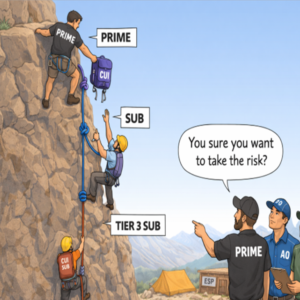
Tiered supply chains add complexity:
Tier 1 (Prime contractors): Direct contract with the government; responsible for ensuring all subcontractors comply.
Tier 2 (Subcontractors): Work directly with primes; may or may not handle CUI depending on their role.
Tier 3+ (Sub-subcontractors): Further removed from the prime contract; often lose context about why data is sensitive or what compliance is required.
Tiered risk is often missed because data becomes abstracted at each level. A bolt or chemical mixture for a fighter jet may not seem sensitive to a Tier 3 supplier, but the specifications and designs are CUI. Each contracting officer (prime, sub, sub-sub) may dilute or misinterpret flow down language, leading to “whisper down the lane” problems. Smaller, less sophisticated subcontractors may lack full-time compliance professionals, resulting in gaps in understanding and implementation.
Strong organizations manage tiered risk by:
-
- Mapping the supply chain: Identify all subcontractors by tier and document which ones have access to CUI.
-
- Tracking CMMC level requirements: Ensure each tier understands the Level of compliance (Level 1-3) and type of CUI that needs safeguarding.
-
- Requiring SPRS affirmations: Obtain attestations from each tier confirming their compliance status.
-
- Re-evaluating when changes occur: When new subcontractors are added, tools are introduced, or contracts are modified, reassess flow down requirements.
-
- Maintaining contract privity: Understand the contractual relationships at each tier to ensure proper flow down language and enforcement mechanisms are in place.
Liability doesn’t stop at Tier 1. Primes are ultimately responsible to the government for all subcontractor compliance, making robust supply chain risk management essential. DFARS Subpart 204.75 provides contracting officers with clear instructions on when CMMC clauses must be included and what must be verified before contract award or performance extension.
Compliance Drift and How to Manage It
Compliance drift is the gradual degradation of security controls and compliance posture over time due to system changes, personnel turnover, new tools, or inadequate monitoring. Technology evolves, business needs change, vendors update services, and employees come and go. Without continuous, active management, compliance erodes.
Unmanaged drift creates risks including the potential of creating significant changes to scope, architecture, or data flows that may trigger the need for a new CMMC assessment, contract violations (if systems no longer match the documented scope submitted to contracting officers, adverse contract action may result), and security incidents (drifted controls create vulnerabilities that can lead to data breaches, which carry reporting obligations and potential False Claims Act exposure).
A framework for managing compliance drift includes:
Change control processes: Review, document and approve all changes to in-scope systems before implementation. Assess whether changes are “significant” under current CMMC definitions.
Continuous monitoring: Implement automated tools to detect configuration changes, unauthorized access, or deviations from approved baselines.
Regular internal assessments: Conduct periodic reviews (quarterly or semi-annually) to verify controls remain effective and documentation is current.
Maintain accurate inventories: Keep up-to-date lists of assets, users, and external service providers. Treat these lists as living documents, not static snapshots.
Update documentation: Ensure System Security Plans, Plans of Action and Milestones (POA&Ms), and other required documents reflect current reality.
External service providers can help manage drift by providing continuous monitoring, automated configuration management, and compliance reporting—but only if the contractor maintains clear communication and well-defined boundaries. Demonstrating good faith effort through documented processes and regular assessments can mitigate legal risk even if compliance drift or mistakes occur.
How to Help Your MSP Reduce Your Risk
MSPs can accelerate CMMC readiness and reduce operational burden, but only if contractors engage effectively. Contractors must enable their MSPs to succeed by:
Communicating clearly: Establish structured communication channels for submitting requests, reporting issues, and tracking changes. Ambiguity creates risk.
Defining boundaries: Document the scope of the MSP’s responsibilities and the contractor’s retained responsibilities in a Shared Responsibility Matrix (SRM) or Customer Responsibility Matrix (CRM).
Providing context: Help the MSP understand your business model, contract requirements, and data flows so they can tailor solutions appropriately.
Maintaining administrative responsibilities: Recognize that no MSP can eliminate all contractor obligations. Certain administrative tasks (user management, policy enforcement, incident reporting) remain with the contractor.
Participating in assessments: Work collaboratively with the MSP during mock assessments and audits. The MSP provides technical evidence, but the contractor must demonstrate understanding and ownership.
Choosing the right MSP matters. Look for providers with CMMC Level 2 certification, ensure their contracts address regulatory compliance, confirm they provide required documentation such as service descriptions and a Customer Responsibility Matrix (CRM), and verify they can produce evidence that controls are properly implemented.
Organizations seeking qualified providers can reference the MSP Collectives’ Certified ESP Directory.—a community-maintained, no-fee resource that helps defense contractors identify CMMC-certified managed service and managed security providers aligned with CMMC and NIST SP 800-171.
In an environment where responsibility for protecting CUI ultimately rests with the contractor, working with verified providers reduces risk and strengthens confidence in the services supporting your environment.
Even with a certified MSP, contractors should conduct periodic reviews and mock assessments to confirm that services remain compliant over time. MSPs are not a “set it and forget it” solution—they are part of a broader compliance strategy that requires ongoing contractor engagement.
From Surviving to Thriving in the CMMC Enforcement Era
As CMMC enforcement is now live, subcontractors must proactively manage risk throughout the contract lifecycle. Scope ownership, accurate reporting, and supply chain risk management are critical to avoiding contract friction, reassessment costs, and legal exposure. CMMC flowdown requirements create shared responsibility across tiers, requiring primes and subs to work collaboratively to ensure compliance. Compliance drift is inevitable without active management through change control, continuous monitoring, and regular assessments. MSPs can accelerate readiness, but only when contractors maintain clear communication, well-defined boundaries, and administrative accountability.
CMMC is not just about passing an assessment—it’s about building sustainable security practices that protect sensitive data, strengthen supply chain relationships, and position contractors for long-term success.
Take action by reviewing and validating your SPRS scores and System Security Plans, mapping your supply chain and verifying subcontractor compliance, implementing change control and continuous monitoring processes, and engaging CMMC certified MSPs or qualified advisors to fill expertise gaps.
Learn more about NeoSystems’ BASE and FRAME solutions, which provide CMMC-ready environments and reduce the burden of achieving and maintaining compliance.
Organizations that invest in managing CMMC risk today will be better positioned to compete, win contracts, and thrive in an increasingly compliance-driven defense market.